Showing posts with label Ethereal. Show all posts

Friday, December 17, 2010

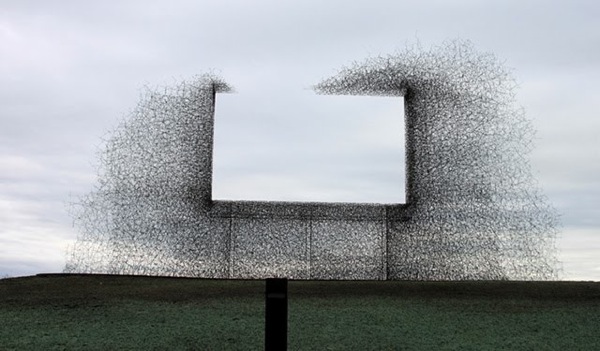
Non-Sign II

Non-Sign II. Image courtesy of Flavorwire


Lead Pencil Studio is a firm based in Seattle, Washington, created by Annie Han and Daniel Mihalyo. They constantly blur the line between architecture and art and Non-Sign II is yet another manifestation of this blending. 

Non-Sign II is a billboard, or a non-billboard, really. It is located near the border of the United States and Canada and was commissioned by the US Government. "The billboard-shaped void contrasts with the omnipresent advertising hoardings of the surrounding area, inviting viewers to concentrate instead on the natural beauty of the landscape." 
Non-Sign II. Image courtesy of Flavorwire


Although the Non-Sign II would not traditionally be considered a work of craft, it embodies craft through its' technique of woven strands of steel. It is interesting how the purpose of the project was to focus the viewers' eye on the natural landscape, rather than a sign selling a product or service. The act of using the woven texture, which historically is linked to folk art and an "earthy" art form with natural fibers, evokes an appreciation of the landscape. Yet with the introduction of man-made steel as the fiber that serves as the lens to view the landscape provides a contradictory yet visually stunning approach. Perhaps Lead Point Studio was aware of this ironic juxtaposition, or perhaps they just wanted to create a shocking commentary on our attention spans and consumerism.

Tuesday, December 14, 2010

Loie Fuller

Henri de Toulouse-Lautrec, Loie Fuller, 1892.
Image courtesy of www.abcgallery.com
Loie Fuller was born in Illinois in 1862. She was a visionary in the field of dance, inventing new ways to create form through movement. Her main canvas was the silk fabric that she wore while dancing, and by holding long poles, she extended the reach of her media. She also introduced electric lighting to change the visual effects of her dance. 

She moved to Paris in the 1890s, where her fluid artforms gained her attention from many artists, such as Toulouse-Lautrec and her use of technology caught the eye of revolutionary scientists, such as Marie Curie. 

Fuller's Serpentine Dance is included in the Museum of Modern Art's current exhibition, On Line. With the The Serpentine Dance she manipulated the silk, physically by using the bamboo rods and visually with the light. As noted on the MoMA website, she is widely recognized as having been influential on the Cubists and Futurists for her use of fabric to create movement in three-dimensional space, which they aimed to do through sculpture and painting.

In the late 1800s, Fuller was using fabric to change contemporary ideals in various artforms, including dance, art, film, science and technology. Historically, there are not many individuals who have had that significant of an impact on so many fields simultaneously. 

Tuesday, December 7, 2010

Gabriel Dawe

Plexus No. 3
Image courtesy of http://www.gabrieldawe.com/


Gabriel Dawe is a native of Mexico City and worked as a graphic designer before foraying into fiber arts. From his website: 
In search for creative freedom he started experimenting and creating artwork, which eventually led him to explore textiles and embroidery—activities traditionally associated with women and which were forbidden for a boy growing up in Mexico. Because of this, his work is subversive of notions of masculinity and machismo that are so ingrained in his culture. By working with thread and textiles, Dawe’s work has evolved into creating large-scale installations with thread, creating environments that deal with notions of social constructions and their relation to evolutionary theory and the self-organizing force of nature.
The social constructions that Dawe is creating are comparable to some of the diagrams that are used in network society to show the various ways that we connect with our peers. The spiderweb-like creations with linear connections could easily be seen as social diagrams, connecting him simultaneously to his past and future. However, the Plexus series, which has been exhibited in Dallas where he is working on an MFA, is more about an architectural construct than the duality and contradiction of his forbidden craft. In an interview with My Modern Met, Dawe stated: 
Conceptually, these works are about the human need for shelter... Fashion and Architecture have many functions, but one thing they both share is that they protect us from the elements. I'm taking the main material that clothing is made out of—thread—to make an architectural structure. By reversing scale and material in this way, I end up with a structure that I see as symbolic of the social constructions humans need to survive as a species.
Considering how early it is in Dawe's career, he's already captivating an audience who wants to escape into his dreamy spaces. From the sound of it though, you can't really capture the true nature of his installations with photographs, so hopefully he'll be showing in New York sometime soon...