Showing posts with label Publics. Show all posts

Sunday, December 19, 2010

The Giant Knitting Nancy

At the London Festival of Architecture this Summer, a giant knitting installation was assembled as an interactive seating component. The Giant Knitting Nancy was designed by London design collaborative Superblue. The theme of the LFA was "The Welcoming City" and the Giant Knitting Nancy invited passerbys into the installation area to help knit the piece, or to just hang out and sit on the balls that are covered with knitting! The knitted piece also represented network cultures woven together through the festival.
Pictures courtesy of Superblue




Friday, December 17, 2010

Non-Sign II

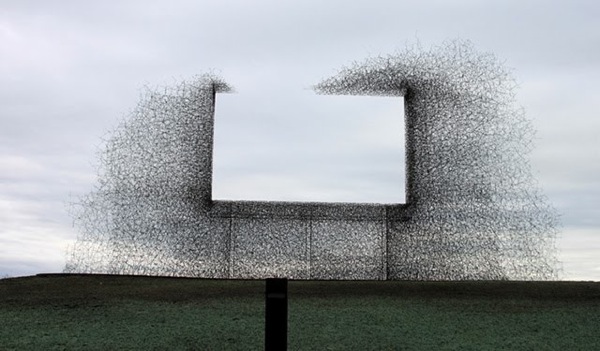
Non-Sign II. Image courtesy of Flavorwire


Lead Pencil Studio is a firm based in Seattle, Washington, created by Annie Han and Daniel Mihalyo. They constantly blur the line between architecture and art and Non-Sign II is yet another manifestation of this blending. 

Non-Sign II is a billboard, or a non-billboard, really. It is located near the border of the United States and Canada and was commissioned by the US Government. "The billboard-shaped void contrasts with the omnipresent advertising hoardings of the surrounding area, inviting viewers to concentrate instead on the natural beauty of the landscape." 
Non-Sign II. Image courtesy of Flavorwire


Although the Non-Sign II would not traditionally be considered a work of craft, it embodies craft through its' technique of woven strands of steel. It is interesting how the purpose of the project was to focus the viewers' eye on the natural landscape, rather than a sign selling a product or service. The act of using the woven texture, which historically is linked to folk art and an "earthy" art form with natural fibers, evokes an appreciation of the landscape. Yet with the introduction of man-made steel as the fiber that serves as the lens to view the landscape provides a contradictory yet visually stunning approach. Perhaps Lead Point Studio was aware of this ironic juxtaposition, or perhaps they just wanted to create a shocking commentary on our attention spans and consumerism.

Monday, December 13, 2010

Pink M.24 Chaffee


In 2006, a combat tank from World War II was placed in front of the Nikolaj Contemporary Art Center in Copenhagen, Denmark. Volunteers were responsible for crocheting and knitting pink squares to construct a blanket to completely cover the tank. Though passerbys were free to contribute squares to the project. The "pink tank," as it is sometimes called, was a form of protest against Denmark's involvement in the Iraq war. Over 4,000 squares were used to create the blanket, representing the wide spread of global protest.

From the Pink M.24 Chaffee website:
Unsimilar to a war, knitting signals home, care, closeness and time for reflection... For me, the tank is a symbol of stepping over other people's borders. When it is covered in pink, it becomes completely unarmed and it loses it's authority. Pink becomes a contrast in both material and color when combined with the tank.
The artist responsible for the "Pink Tank" is Marianne Jørgensen. She got submissions from knitting groups from all over the world through the widespread network culture. Today, with websites like Ravelry, an online knitting and crocheting community, which has over one million members, Jørgensen probably could have expanded her outreach exponentially. 

Wednesday, December 8, 2010

Lacey Jane Roberts

& CRAFTS
Screenshot of http://www.laceyjaneroberts.com/


Lacey Jane Roberts is a graduate of the California College of Arts, which used to be known as the California College of Arts & Crafts. The CCA voted to take the "& Crafts" out of the name because they thought it negated the high art that they wanted to be associated with. Roberts took this as an attack against history, tradition, and feminism which is integral to the Art of Craft, so she hand-knit "& Crafts" and put it back in its place on the façade of this building. This guerilla style knitting or graffiti is common in Robert's work, which typically involves a play between "feminine" handicraft and violence throughout the world, such as in the pink knit barbed wire fence of We couldn't get in. We couldn't get out.
We couldn't get in. We couldn't get out.
Screenshot of http://www.laceyjaneroberts.com/


She also works with the relationship of tool to craft, "reclaiming the mastery of craft to create an alternative set of tools that could potentially dismantle 'the master's house.'" This has an air of self-destruction, because as she states on her website, "to 'master' is to wield power over others, but 'to master' in the context of craft is to possess a self-sufficient creative agency over materials and tools." So, she is, in a sense, dismantling her own craft through her making of a new form of tool. 
Spinning (taking back control)
Screenshot of http://www.laceyjaneroberts.com/


Roberts is currently teaching at Virginia Commonwealth University, one of the top fiber arts schools in the country. 

Tuesday, December 7, 2010

Christo and Jeanne-Claude


Last night, I went to the Architectural League's Current Work lecture series at The Cooper Union, featuring Christo. Although Christo and Jeanne-Claude are not considered "craft" artists in the traditional sense, they're use of fabric as a dynamic and unexpected canvas makes them an interesting addition to this collection. It is obvious that Christo and Jeanne-Claude worked very hard to stay away from the typical artist persona and to pave a new road for the art world. He very strongly reminded the audience that they pay for everything involved in the creation of their very large scale works from the sales of their conceptual drawings and collages that he does with his own hands. Of course, Christo was on his toes and he had some amazing responses to the varied questions in the audience. 

Someone in the audience asked a fairly lengthy question about how the digital world, ie Social Media, has changed his process of working. Christo responded in a not-so-direct, but appropriate manner. To paraphrase: 
Artists, in general, do illustrative works. When you walk into a museum, the paintings on the wall are representations, illustrations. Christo and Jeanne-Claude's work is presented in two different manners. There are the representations, which exist as the conceptual sketches, when they are trying to convince people to let them do the work, and even the photographs of the projects. Then, there is the real thing, like the physical Wrapped Reichstadt (not the photographs or sketches). The illustrations and representations are not real, therefore most artists never do real things. But Christo and Jeanne-Claude do both, but there is a radical difference between the representation and the real thing. The real thing is temporary, it only lasts for a few days or weeks, but the representations are permanent.
Despite Christo's dismissal of the digital world, their works always trope on issues in contemporary society, in a delicate way. Yes, they are very large scale, therefore unavoidable, but the use of fabric softens their approach. Each work is serving as a subliminal call to action, for the environment, politics, economics, and more.

In a current society of immediacy, Christo and Jeanne-Claude represent patience. Most of their projects took decades to complete, but are timeless in nature, so despite the fact that such a long time passed from inception to delivery, they're works are always relevant, whether the representation or the real.

Monday, December 6, 2010

KnittaPlease

The columns at the National Gallery of Art are tagged in 2009.
Image courtesy of flickr user The Shopping Sherpa


KnittaPlease is a group of anonymous knitters who have been tagging the urban environment with yarn bombings since 2005. You've probably seen them somewhere in the city: a meter, a stop sign, a tree, and on and on. It started as a "response to the dehumanizing qualities of an urban environment. By inserting handmade art in a landscape of concrete and steel, she adds a human quality that otherwise rarely exists." The softness of the fabric in conjunction with the building materials is a new type of spatial graffiti. For a while, on the KnittaPlease website, you could download tags, print them out and attach them to your own knitting graffiti, and they accumulated projects all over the globe, expanding their network far beyond the initial Texas crew. (There is a Knitta Book that is a compilation of global tags in the works). There is also a blog which chronicles their travels and artwork. They have also started doing ad campaigns for clothing companies, apparently? It will be interesting to see how they ride the line between mainstream advertising and underground art culture...

microRevolt

Cat Mazza, Image courtesy of http://www.juliachristensen.com/


Cat Mazza is an artist who created microRevolt, which brings together craftivists from all over the world and "develops projects which combine knitting with machines, and digital social networks to investigate and initiate discussion about sweatshop labour." (From We Make Money Not Art interview) Their biggest project to date is a petition to Nike about their use of sweatshops. The petition exists as a 15 foot wide blanket that displays the Nike Swoosh, made up of 4 inch squares sent by knitters from over 30 countries. The corresponding website has links of each country exhibited, and if you click on any country, white squares will appear on the blanket, showing the location of all of the contributors from that country, and if you scroll over the white square, the name of the contributor will also appear (see below, Iceland is highlighted, with one knitter contributing a square from Reykjavik.) This allows us to see the network of knitters that she obtained through a Network Society, ie Social Media.


knitPro Chart for 
The Infrastructural City
In order to gain more and more contributions, Mazza put a free knitting chart maker on the microRevolt website, called knitPro, with an option to donate through PayPal or to contribute a square to the Nike petition. With knitPro, you can upload any image and the program will turn it into a chart, which can then be knit or embroidered (this goes back to the idea of 0s and 1s being the foundation of knitting.. everything is based on a grid system). So, Mazza provides a free service that's tucked in the microRevolt website, in hopes of further disseminating her activism.

During a lecture at the Textile Arts Center this November given by Sabrina Gschwandter, an audience member asked if Mazza had given the Nike blanket to the Nike executives, which was originally part of the plan. Gschwandter, a fiber artist and writer, responded by saying that the blanket is still traveling around in different art venues around the country, which is probably proving to have a more significant impact than if Mazza handed the blanket over to Nike. Through the continual travel of the 15 foot blanket, Mazza's spreading her vision to more and more people, even two years after the blanket was completed. If she had just handed it over, it probably would have disappeared and the message would have been forgotten soon after. Instead, each time the blanket reaches a new location, more Revolutionaries join the fight against sweatshop labor. 

Sunday, December 5, 2010

Open Source Embroidery

HTML Patchwork by Ele Carpenter
Image courtesy of flickr user Furtherfield


Open Source Embroidery: Craft and Code is an art movement that combines technological practices through embroidery, knitting, quilting, weaving, and other crafts. It was first displayed at an exhibition in London in 2008 at the http:// gallery and has since traveled to Sweden and the United States. 

When I explain the concept of knitting to a non-knitter, I always start with comparing knitting to binary code. Binary code consists of 0s and 1s, and by combining these two elements, you can get endless systems, creating the foundation of our Network Culture. Knitting is very similar in theory. There are just two stitch types: knit and purl. Every sweater, scarf, hat, glove, etc. consists of just these two basic elements, and through the manipulation of these two elements, you can create endless combinations. Easy, right? Ele Carpenter, the creater/curator of Open Source Embroidery uses a similar approach to explain her reasoning for combining Craft and Code:

"Embroidery is constructed (mostly by women) in hundreds of tiny stitches which are visible on the front of the fabric. The system of the stitches is revealed on the back of the material. Some embroiderers seal the back of the fabric, preventing others from seeing the underlying structure of the pattern. Others leave the back open for those who want to take a peek. A few integrate the backend process into the front of the fabric. The patterns are shared amongst friends in knitting and embroidery 'circles'.
Software is constructed (mostly by men) in hundreds of tiny pieces of code, which form the hidden structure of the programme or interface. Open Source software allows you to look at the back of the fabric, and understand the structure of your software, modify it and distribute it. The code is shared amongst friends through online networks. However the stitches or code only make sense to those who are familiar with the language or patterns.
The same arguments about Open Source vs Free Software can be applied to embroidery. The needlework crafts also have to negotiate the principles of 'freedom' to create, modify and distribute, within the cultural and economic constraints of capitalism. The Open Source Embroidery project simply attempts to provide a social and practical way of discussing the issues and trying out the practice. Free Software, Open Source, amatuer and professional embrioderers and programmers are welcome to contribute to the project."

Carpenter initiated The HTML Patchwork, shown in the image above, consisting of 216 hexagonal pieces of fabric in websafe colors quilted together. All contributors have a background in craft AND code, so that each piece is a genuine compilation of the low-tech/high-tech mentality. There is a wiki site for each participant to share the story of their patch and their history with craft.

The Open Source Embroidery project was featured in WIRED magazine's Gadget Lab section (showcasing "hardware that rocks your world"), titled "Geek Art: Needlework Brings Together Programmers, Crafters." The article corresponded with the US opening of the exhibition. 

Knitted Blog by Suzanne Hardy
Image courtesy of flickr user Furtherfield


Knitted Blog used Open Source networking to gather all of the components from knitters around the world, then all of the "knittivists" (like craftivists) could post their contributions to the glittyknittykitty blog. Each piece was sent to multiple participants and was continuously added to, diminishing a sort of ownership, and establishing an arena for creative commons.

Friday, December 3, 2010

Urban Craft Uprising


This weekend, Seattle is hosting a craft show for indie artisans called Urban Craft Uprising. Started in 2004, the show aims to foster the craft world by providing "unique, high quality, hand-crafted alternative to 'big box' stores and mass produced goods." All material is chosen by a jury, to ensure the highest quality possible. They also manage a blog, highlighting and interviewing the various artists/vendors who will be at the show.

The show also provides a unique type of Public for artisans and consumers. The vendor space will allow artisans to sell their works for income, while also providing a common area for attendees to practice their craft. There are also demonstration sessions, adding an educational opportunity as well.

Independent fairs such as Urban Craft Uprising provide a great opportunity for artisans to gather, share, and make some money to further increase their craft. (Or in the consumer's case, spend money to further increase their craft). It also allows the general public to gain acces and support these small (mostly local) businesses. It's strategic timeframe of early December is perfect for Holiday shopping, further supporting these craft businesses. Since its inception, the attendance has increased to more than 8,000 guests, with 130 vendors. They have also added a Summer show to their annual schedule. 

Artwork by Anna Hrachovec of Mochimochi Land via Urban Craft Uprising


The Drawing above is a playful advertisement for the show, mixing craft and the urban environment! Perfect for exhibiting the potential venues of craftivism + urbanism together.