
Showing posts with label Social Media. Show all posts
Showing posts with label Social Media. Show all posts
Thursday, December 16, 2010
Craft Mafia

Wednesday, December 15, 2010
Knit Your Bit


In contrast to the M.24 Chaffee, a different type of wartime knitting was organized by the Red Cross. Knit Your Bit was an effort to gather handknit garments for soldiers. Volunteers were part of a "Production Corps"and would knit everything from socks to sweaters. This was meant to support American Troops with warm clothing. The tradition is still alive today with knitters making helmet liners for troops in Iraq and Afghanistan.
The Production Corps represents social networking and network theory in that at the national level, there were many women and children knitting for the cause. Together they formed the Production Corps, yet they were not necessarily ever in the same locale. They were joined together through this invisible network of knitters who were all working towards the support of soldiers. Thus the knitters were all contributing in their own way to the war efforts.
Posters (Screenshots of Redcross website): Left, L.N. Britton, 1918. Right, Wladyslaw Teodor Benda, 1918.
Monday, December 13, 2010
Pink M.24 Chaffee
In 2006, a combat tank from World War II was placed in front of the Nikolaj Contemporary Art Center in Copenhagen, Denmark. Volunteers were responsible for crocheting and knitting pink squares to construct a blanket to completely cover the tank. Though passerbys were free to contribute squares to the project. The "pink tank," as it is sometimes called, was a form of protest against Denmark's involvement in the Iraq war. Over 4,000 squares were used to create the blanket, representing the wide spread of global protest.
From the Pink M.24 Chaffee website:
Unsimilar to a war, knitting signals home, care, closeness and time for reflection... For me, the tank is a symbol of stepping over other people's borders. When it is covered in pink, it becomes completely unarmed and it loses it's authority. Pink becomes a contrast in both material and color when combined with the tank.The artist responsible for the "Pink Tank" is Marianne Jørgensen. She got submissions from knitting groups from all over the world through the widespread network culture. Today, with websites like Ravelry, an online knitting and crocheting community, which has over one million members, Jørgensen probably could have expanded her outreach exponentially.
Thursday, December 9, 2010
Knit a Neuron
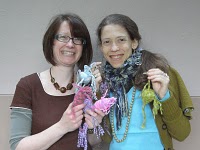 |
Anne & Helen Image courtesy of Knit a Neuron |
Even NPR's Robert Krulwich is talking about them! Yesterday, in discussing the possibilities of living clouds and arsenic life, Krulwich says "I don't think these 'brain cells' are even remotely alive – though they are gorgeous – but as Chris Impey says: 'The possibilities may simply be limited by our imaginations.'" Anne and Helen obviously have fantastic imaginations, since their project has been so successful!
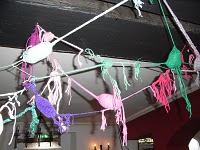 |
| Close up of the neurons Image courtesy of Knit a Neuron |
Tuesday, December 7, 2010
Christo and Jeanne-Claude

Last night, I went to the Architectural League's Current Work lecture series at The Cooper Union, featuring Christo. Although Christo and Jeanne-Claude are not considered "craft" artists in the traditional sense, they're use of fabric as a dynamic and unexpected canvas makes them an interesting addition to this collection. It is obvious that Christo and Jeanne-Claude worked very hard to stay away from the typical artist persona and to pave a new road for the art world. He very strongly reminded the audience that they pay for everything involved in the creation of their very large scale works from the sales of their conceptual drawings and collages that he does with his own hands. Of course, Christo was on his toes and he had some amazing responses to the varied questions in the audience.
Someone in the audience asked a fairly lengthy question about how the digital world, ie Social Media, has changed his process of working. Christo responded in a not-so-direct, but appropriate manner. To paraphrase:
Artists, in general, do illustrative works. When you walk into a museum, the paintings on the wall are representations, illustrations. Christo and Jeanne-Claude's work is presented in two different manners. There are the representations, which exist as the conceptual sketches, when they are trying to convince people to let them do the work, and even the photographs of the projects. Then, there is the real thing, like the physical Wrapped Reichstadt (not the photographs or sketches). The illustrations and representations are not real, therefore most artists never do real things. But Christo and Jeanne-Claude do both, but there is a radical difference between the representation and the real thing. The real thing is temporary, it only lasts for a few days or weeks, but the representations are permanent.Despite Christo's dismissal of the digital world, their works always trope on issues in contemporary society, in a delicate way. Yes, they are very large scale, therefore unavoidable, but the use of fabric softens their approach. Each work is serving as a subliminal call to action, for the environment, politics, economics, and more.
In a current society of immediacy, Christo and Jeanne-Claude represent patience. Most of their projects took decades to complete, but are timeless in nature, so despite the fact that such a long time passed from inception to delivery, they're works are always relevant, whether the representation or the real.
Monday, December 6, 2010
microRevolt
 |
| Cat Mazza, Image courtesy of http://www.juliachristensen.com/ |
Cat Mazza is an artist who created microRevolt, which brings together craftivists from all over the world and "develops projects which combine knitting with machines, and digital social networks to investigate and initiate discussion about sweatshop labour." (From We Make Money Not Art interview) Their biggest project to date is a petition to Nike about their use of sweatshops. The petition exists as a 15 foot wide blanket that displays the Nike Swoosh, made up of 4 inch squares sent by knitters from over 30 countries. The corresponding website has links of each country exhibited, and if you click on any country, white squares will appear on the blanket, showing the location of all of the contributors from that country, and if you scroll over the white square, the name of the contributor will also appear (see below, Iceland is highlighted, with one knitter contributing a square from Reykjavik.) This allows us to see the network of knitters that she obtained through a Network Society, ie Social Media.

 |
knitPro Chart for The Infrastructural City |
In order to gain more and more contributions, Mazza put a free knitting chart maker on the microRevolt website, called knitPro, with an option to donate through PayPal or to contribute a square to the Nike petition. With knitPro, you can upload any image and the program will turn it into a chart, which can then be knit or embroidered (this goes back to the idea of 0s and 1s being the foundation of knitting.. everything is based on a grid system). So, Mazza provides a free service that's tucked in the microRevolt website, in hopes of further disseminating her activism.
During a lecture at the Textile Arts Center this November given by Sabrina Gschwandter, an audience member asked if Mazza had given the Nike blanket to the Nike executives, which was originally part of the plan. Gschwandter, a fiber artist and writer, responded by saying that the blanket is still traveling around in different art venues around the country, which is probably proving to have a more significant impact than if Mazza handed the blanket over to Nike. Through the continual travel of the 15 foot blanket, Mazza's spreading her vision to more and more people, even two years after the blanket was completed. If she had just handed it over, it probably would have disappeared and the message would have been forgotten soon after. Instead, each time the blanket reaches a new location, more Revolutionaries join the fight against sweatshop labor.
Subscribe to:
Posts (Atom)