Showing posts with label Network Culture. Show all posts

Monday, December 20, 2010

Knit a River

Knit a River, Photo Courtesy of iknitlondon


Knit a River is a project that perfectly embodies the Craftivist collision with Network Cultures. It was organized by the London group I Knit in conjunction with WaterAid, a charity organization that aims to provide access to safe water all over the globe, as a protest to raise awareness for this inequality. In June of 2006, I Knit invited the global knitting population to contribute to the project by sending six inch blue squares. The squares would then be sewn together to make a patchwork blanket of squares from all over the world. 

I Knit received 100,000 blue squares and the blanket traveled to venues around Europe in parades or draped across surfaces to invite people to hang out in the "river." In May 2007, over 200 knitters and WaterAid volunteers joined to carry part of the river down the Albert Embankment to give to the Prime Minister in order to put the issue in the spotlight right before the G8 Summit.

Knit a River, Photo Courtesy of iknitlondon
Knit a River embodies the type of peaceful protest that can occur when likeminded individuals come together to promote change. Through the use of a global network, I Knit was able to exponentially increase their workforce, just the type of activities which occur when social networks and services crowd source their online communities.

Sunday, December 19, 2010

The Giant Knitting Nancy

At the London Festival of Architecture this Summer, a giant knitting installation was assembled as an interactive seating component. The Giant Knitting Nancy was designed by London design collaborative Superblue. The theme of the LFA was "The Welcoming City" and the Giant Knitting Nancy invited passerbys into the installation area to help knit the piece, or to just hang out and sit on the balls that are covered with knitting! The knitted piece also represented network cultures woven together through the festival.
Pictures courtesy of Superblue


Thursday, December 16, 2010

Craft Mafia


The Craft Mafia was established to "promote sister groups in other cities, share web traffic, and provide helpful information to other professional craft designers and groups." There are mafia "familia" in cities around the US and groups can apply to become part of the Mafia, but there are strict guidelines as to who can be permitted. In a sense, the original Craft Mafia (from Austin, Texas) is curating their own group of craftivists. The various Craft Mafia familia organize craft shows, such as the DIY Trunk Show (Chicago) and Handmade Holiday (Richmond). There is also a blog where all of the familia can contribute their crafty efforts. The whole Craft Mafia network culture was established to promote each other's business practices.

Sunday, December 12, 2010

The Counterfeit Crochet Project

The Counterfeit Crochet Project (Critique of a Political Economy) was started in 2006 by Stephanie Syjuco, an artist from San Francisco, who has always had an interest in "piracy and bootlegging as they apply to today's globalized economy." Syjuco started a website, inviting fellow crocheters to join her in counterfeiting high-end, luxury designer handbags. Each contributor chooses their handbag of choice and replicates it in their own unique manner, using the basic design and logo, but adding flair when necessary. For Syjuco, the resulting "mistranslation is quite beautiful." She provides some patterns for knockoff logos, such as Chanel, Fendi, and Gucci, but also loves seeing what other pattern makers come up with. The Counterfeit Crochet Project has been featured in exhibitions all over the world, from China to the Philippines to Turkey, and Syjuco has given workshops on counterfeiting in conjunction with these exhibitions, while also teaching crochet in the gallery spaces. Taking over a gallery space with tables, cheap yarn, and crocheting lessons is a secondary juxtaposition of our typical gallery environment of "high art" with an interactive playground-like atmosphere.

From The Counterfeit Crochet Project's website:
It seems to me that ingenuity and inventiveness lays at the heart of those who decide to make things for themselves. Crafting is overlooked, even denigrated as a viable 'vernacular' form of expression. I view the impetus to handmake something in an era of mass production a personal and perhaps even political act, a way to give yourself agency to create and produce in an age of standardization and retail.
Syjuco says you can look at the project as outsourcing of labor, gathering crocheters to execute these handbags, but she prefers to look at it as a collaboration between likeminded individuals. Either way, they are simultaneously undermining and promoting these luxury goods... some people would look at the bags and think they must really love the designer, or that the bag could possibly be an authentic new design from the fashion houses. But mostly they are taking using handcraft to mock highly crafted design. Of course, some of the bags are made in China, but some of the bags/items are couture - completely made by hand. Isn't it ironic?

Nevertheless, Syjuco is gathering the masses through network society to campaign against issues of consumerism, materialism, industrialization, and all other issues inherent in capitalism. And through the exhibition of these materials, she is allowing the makers to contribute to the vision, while still maintaining ownership of their fabrication, thus the subject as owner/maker is clearly defined. Value, on the other hand, is somewhat fuzzy because it straddles the line between Value as artpiece or movement and Value as was first assigned through the creation of the authentic luxury good. See a video on the project for more explanation and imagery of the exhibitions and submissions.

Saturday, December 11, 2010

Craftivist Collective

Sarah Corbett was blogging as A Lonely Craftivist when fellow knitters started asking her about a potential collaboration. She then started the Craftivist Collective to join knittivists to create projects "to expose the scandal of global poverty, and human rights injustices though the power of craft and public art. This will be done through provocative, non-violent creative actions." There are two groups who meet in England, but they present their work and have collaborators all over the world. You can also get kits from them to perform the same type of work, no matter your location. They use the global network that the internet provides to expand their physical network and they invite any level of crafters to join their efforts. And when they meet, they sometimes get guest artists to come and present their works.
To the left is a collage of the Craftivist Collective's latest project (courtesy of their website), which was a Bed-In in conjunction with John Lennon's 70th birthday in October. The Bed-In was a peaceful protest to promote awareness of issues local and global with a Beatles perspective (ie All you Need is Love), by "sewing and stitching their way to peace... to show how inequality in all forms causes conflict." Below is the progress on the quilt, from craftivists all over the world portraying their peace patches.

Thursday, December 9, 2010

Knit a Neuron

Anne & Helen
Image courtesy of Knit a Neuron
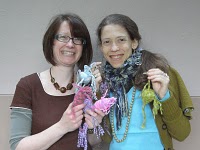
Knit a Neuron was started by two scientists in England. Anne is a knitter and Helen, a crocheter. They wanted to combine their love of science and fiber arts, and so Knit a Neuron was created. They started a blog and posted a call for knitted entries, for which they provided several patterns for knitting and crocheted neurons. They hoped to collect enough from all over the world to create a large brain sculpture that shows what a brain looks like after having gone through a stroke. They hosted several knitting nights at Science Cafe, which is an informal meeting (at a bar) to discuss emerging technologies and science. Several people, men and women of all ages, joined together to knit and crochet neurons for the project. Aside from these knitting nights, they have used the internet to obtain many of their entries, expanding their project and vision far beyond their local community. Thus the value of the Network Culture has helped them immensely to take their high-tech (neurons & imaging) and low-tech (knitting & crocheting) even further into the realm of high-tech (network society)! 

Even NPR's Robert Krulwich is talking about them! Yesterday, in discussing the possibilities of living clouds and arsenic life, Krulwich says "I don't think these 'brain cells' are even remotely alive – though they are gorgeous – but as Chris Impey says: 'The possibilities may simply be limited by our imaginations.'" Anne and Helen obviously have fantastic imaginations, since their project has been so successful!

Close up of the neurons
Image courtesy of Knit a Neuron
Before permanently installing the piece, it will travel to help fundraise for the "Head Injury Therapy Endowment Fund" They initially planned to install the sculpture in the Clinical Research Imaging Centre in Bristol, England which is opening this Spring, but received so many neurons, that the artwork became too large for the space! They are still trying to decide what to do with it now that they've collected all the neurons. There is no place on their blog that indicates how many neurons they received and from which parts of the world, so hopefully they will put some of that info up in the future!

Sunday, December 5, 2010

Open Source Embroidery

HTML Patchwork by Ele Carpenter
Image courtesy of flickr user Furtherfield


Open Source Embroidery: Craft and Code is an art movement that combines technological practices through embroidery, knitting, quilting, weaving, and other crafts. It was first displayed at an exhibition in London in 2008 at the http:// gallery and has since traveled to Sweden and the United States. 

When I explain the concept of knitting to a non-knitter, I always start with comparing knitting to binary code. Binary code consists of 0s and 1s, and by combining these two elements, you can get endless systems, creating the foundation of our Network Culture. Knitting is very similar in theory. There are just two stitch types: knit and purl. Every sweater, scarf, hat, glove, etc. consists of just these two basic elements, and through the manipulation of these two elements, you can create endless combinations. Easy, right? Ele Carpenter, the creater/curator of Open Source Embroidery uses a similar approach to explain her reasoning for combining Craft and Code:

"Embroidery is constructed (mostly by women) in hundreds of tiny stitches which are visible on the front of the fabric. The system of the stitches is revealed on the back of the material. Some embroiderers seal the back of the fabric, preventing others from seeing the underlying structure of the pattern. Others leave the back open for those who want to take a peek. A few integrate the backend process into the front of the fabric. The patterns are shared amongst friends in knitting and embroidery 'circles'.
Software is constructed (mostly by men) in hundreds of tiny pieces of code, which form the hidden structure of the programme or interface. Open Source software allows you to look at the back of the fabric, and understand the structure of your software, modify it and distribute it. The code is shared amongst friends through online networks. However the stitches or code only make sense to those who are familiar with the language or patterns.
The same arguments about Open Source vs Free Software can be applied to embroidery. The needlework crafts also have to negotiate the principles of 'freedom' to create, modify and distribute, within the cultural and economic constraints of capitalism. The Open Source Embroidery project simply attempts to provide a social and practical way of discussing the issues and trying out the practice. Free Software, Open Source, amatuer and professional embrioderers and programmers are welcome to contribute to the project."

Carpenter initiated The HTML Patchwork, shown in the image above, consisting of 216 hexagonal pieces of fabric in websafe colors quilted together. All contributors have a background in craft AND code, so that each piece is a genuine compilation of the low-tech/high-tech mentality. There is a wiki site for each participant to share the story of their patch and their history with craft.

The Open Source Embroidery project was featured in WIRED magazine's Gadget Lab section (showcasing "hardware that rocks your world"), titled "Geek Art: Needlework Brings Together Programmers, Crafters." The article corresponded with the US opening of the exhibition. 

Knitted Blog by Suzanne Hardy
Image courtesy of flickr user Furtherfield


Knitted Blog used Open Source networking to gather all of the components from knitters around the world, then all of the "knittivists" (like craftivists) could post their contributions to the glittyknittykitty blog. Each piece was sent to multiple participants and was continuously added to, diminishing a sort of ownership, and establishing an arena for creative commons.

Fred Sandback

Fred Sandback surrounded by yarn at Dia: Beacon
Image Courtesy of the Fred Sandback Archive


I first became enamoured with Fred Sandback's work when I visited Dia: Beacon in Beacon, New York. There are many great contemporary art pieces in the museum, which is an amazing space in its own right, but Sandback's use of yarn immediately appealed to me, of course. Sandback's main subject is the line (one of his pieces is in the current MoMA exhibition, On Line) and he achieves the line through yarn, wire, and drawings. His lines frame a Space which is imagined by the viewer. Sometimes there are many lines which create a more complex spatial construct, but many of his sculptures consist of just one string, stretched from one surface to another.  

A 1969 interview between Jörg Hausmann and Fred Sandback reveals the following discussion about Value in art and network culture, a common discussion over the course of this semester, especially in regards to Poetics and subjective ownership. Are there any original ideas anymore, or are we just repeating someone else's maneuvers? In Sandback's opinion, my version of his sculpture is just as valuable as his version. Another Dia: Beacon artist, Sol LeWitt, had a similar approach – the directions for a drawing becomes the artwork, sell them, and then anyone can execute the drawing. 

From "Fred Sandback: Licht, Raum, Tatsachen." Neue Rhein Zeitung, July 4, 1969:
Hausmann: Artists have always dreamed of producing art for everyone, art for small sums of money. It seems to me that artists today do anything but that. The opposite is even the case. As soon as an artist becomes in any way known, gets a few good reviews, or can fall back on an astute manager, the prices rise. What do you think of this development?
Sandback: I'm not sure if what you are saying is quite true. But if you want one of my objects, for example, you can simply imitate it. All you need is a piece of string. . . .
Hausmann: But would I then have a genuine Sandback?
Sandback: Are you claiming that there's something special about my strings that other strings don't have? 


Fred Sandback at Dia: Beacon, 
Image Courtesy of the Dia Art Foundation

Saturday, December 4, 2010

Spincycle Yarns


I have admired Spincycle Handspun Yarns, based in Bellingham, Washington, for quite some time now, but unfortunately, have not had the opportunity to try their yarn out! Spincycle, started in 2005, consists of two "sassy spinsters" who handspin and dye all of their products and then bike to local venues to sell their yarn (hence the cycle in their name – they are car-free). Their mission is to "spin yarn that is both fresh and classic, to inspiring your craft with ever-changing textures and colors, and to advancing the knitting revolution!" 


To add to their environmentally friendly mantra, all of their all-natural raw material comes from local farms, except for one type of fiber that is from the Falkland Islands. The reason that they let this one foreign fiber into their studio is because the farm that breeds the sheep is extremely sustainable, with windmills and no bleaching or harsh chemical treatments on the product. Even the dyes that they use are non-toxic, so it is safe for them, as the makers, the knitters, and for the end-users. They are extremely involved in every part of the creation cycle, from meeting the animals, choosing the fleece, cleaning, dyeing, and spinning the fiber into the final yarn. And although they do sell some of their yarn in stores located in Washington, Oregon, and California, it is mostly available through their online store, so they even know who ends up with the product. Their business model is extremely sustainable (and admirable, in today's economic situation.) 

In fact, their business model provides an interesting comparison to many businesses represented in Network Cultures, especially like those discussed by Nicholas Carr in his article "From the Many to the Few." There are many parallels to be drawn, such as the "few"  involved in the production process, but Spincycle is on such a different scale from the Facebooks and YouTubes of the networked world. Spincycle, since it is managed by just two people, is able to reach its users on a very personal level, allowing the users to feel like they are helping to impact change through environmentally safe products. Users will be more likely to make repeat purchases because of the close interaction of the makers into every stage of the process. This is quite different from the Network, which often takes away the individual experiences that are provided through this type of care put into the production of a good or service. Although, Spincycle is completely networked into society, with a website, online store, Facebook fan page, Ravelry page, Yelp page, Etsy page, etc. However, their success is most likely not due to their being "plugged in" to the network, but due to their sound and friendly practices. (Just to add, I do not know how "successful" they really are as a business, but the fact that they have been around since 2005 is enough indication for me that they are doing something right!)
Grumpy Birds BFL Yarn
Swamp Thing Novelty Yarn
Misanthrope BFL Yarn

Thursday, December 2, 2010

CRAFT Culture


Baudrillard might have found it difficult to locate oneself within a community, however there is a huge, ever-expanding community, that actually parallels network cultures. [CRAFT]work culture is a network based on a rich history of handicraft, dating back thousands of years, all around the globe. One of the earliest global “network cultures,” craft culture has now transformed with changes in contemporary society, to adapt to new technologies, ideologies, and economies. Historically, the quilting bee is known as a network of like-minded individuals, joined together to create an object or artwork, while simultaneously communing over news (i.e. gossip), food and stress-relieving practices. The modern version of a quilting bee manifests itself in various forms today, troping on many different issues in contemporary society.

There is currently a growing movement in the art world called “craftivism.” Betsy Greer, created the term in 2003, defining it as "a way of looking at life where voicing opinions through creativity makes your voice stronger, your compassion deeper & your quest for justice more infinite." It brings together craft + activism to ease unjust issues of society. Historically though, there are many artists who could fall under the rubric of craft-activists. Perhaps some of these artists would not be traditionally considered in the genre of craft, but through their use of certain media and ideas, they have been added to this particular collection.

This curatorial project will exhibit various artists and artisans who have helped transform "craft" into what it is today. It will also include exhibitions, craft shows, businesses, and other efforts to bring together individuals and groups interested in establishing active movements in a contemporary network society. All selected projects will provide a relation to the various topics addressed throughout the semester.